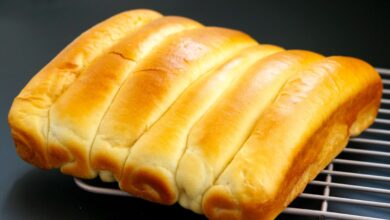
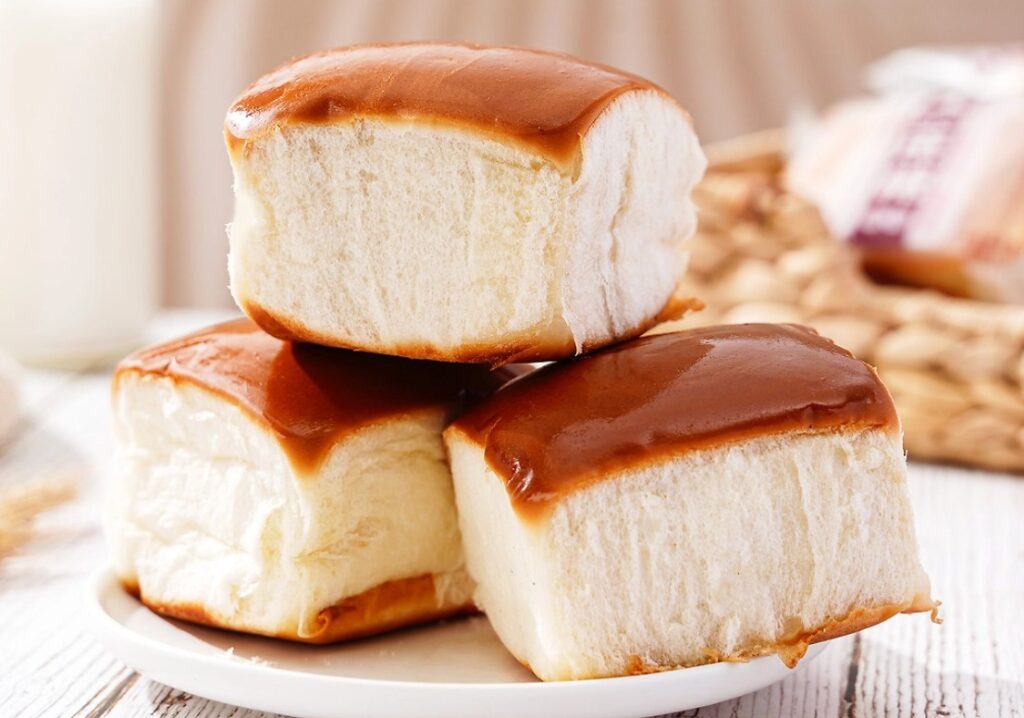
Hokkaido Milk Bread is famous for its super-soft, fluffy texture and slightly sweet, milky flavour. The bread in the image has a beautifully golden-brown, shiny crust on top and a pillowy white interior with a fine, delicate crumb.
It looks light, airy, and tender, practically pulling apart in silky strands — a hallmark of this style of bread. In a small saucepan, whisk 20 g bread flour with 100 ml milk until smooth (no lumps).
Place over medium-low heat, stirring constantly. It will start as thin and milky, but after 1–2 minutes it will thicken into a paste. When you can see the lines from your whisk holding briefly, or it reaches about 65°C (150°F), it’s done.
Scrape into a small bowl, cover with plastic wrap directly on the surface to prevent a skin from forming, and cool to room temperature. Tangzhong pre-gelatinises the starches, allowing the dough to absorb more moisture, resulting in a super-soft texture and improved shelf-life.
In your stand mixer bowl (or large bowl if working by hand): Add 300 g bread flour, 50 g sugar, 1 tsp salt, and 6 g instant yeast. Keep salt and yeast separate when adding so the salt doesn’t inhibit yeast action.
Add all of the cooled Tangzhong, 120 ml warm milk, and 1 large egg, then mix on low speed (or with a spoon) until a rough dough forms — it will look shaggy at first.
Begin kneading on medium speed for about 5 minutes, until smooth and slightly elastic, then gradually add 30 g softened butter, 1 tablespoon at a time, ensuring each portion is fully absorbed before adding more. The dough will seem sticky at this stage.
Keep kneading. Continue kneading for another 8–10 minutes (stand mixer) or 12–15 minutes by hand. The dough should become smooth, elastic, and slightly tacky but not sticky.
Perform a windowpane test: Take a small piece and stretch it gently — if it forms a thin membrane you can see light through without tearing, it’s ready. Avoid adding excess flour, even if sticky at first.
Kneading will help the gluten develop, and the dough will smooth out. Shape dough into a smooth ball and lightly oil a large bowl, and place dough inside, turning it once to coat.
Cover tightly with plastic wrap or a damp towel, then let rise in a warm, draft-free environment until doubled in size (about 1–1.5 hours). Ideal proofing temp is around 26-28°C (78-82°F). If your kitchen is cold, place a bowl in a turned-off oven with just the light on.
Gently punch down dough to degas and turn out onto a lightly floured surface. Divide evenly into 9 pieces (about 65–70 g each for even buns). Shape each piece into a tight ball, then flatten slightly.
Fold edges inward, then pinch seams together underneath. Turn the seam side down and cup your hand over it, gently rolling to form a smooth round.
Arrange in a greased or parchment-lined 8×8-inch baking pan in a 3×3 grid, leaving small gaps between each ball. Cover loosely and let rise at warm room temperature until buns are puffed and almost touching (about 45–60 minutes).
You should see the dough nearly double again — this is key for that airy crumb. Preheat oven to 175°C / 350°F (regular bake, no fan) and beat together 1 egg + 1 tbsp milk to make an egg wash.
Gently brush tops of buns with egg wash for a shiny, golden finish. Bake in the centre rack for 22–25 minutes. Tops should be a rich golden brown, and internal temp should read about 88–90°C (190°F). If the tops brown too quickly, loosely tent with foil for the last 5–7 minutes.
Remove from the oven and let cool in the pan for 5 minutes. Transfer to a wire rack to cool completely or serve warm.
Expert Tips and Troubleshooting:
Key Tips:
- Weigh your ingredients for accuracy, especially flour and liquid.
- Butter should be soft, not melted, for best incorporation.
- Proof in a warm, draft-free environment for consistent rise.
Make-Ahead and Storage:
Make-Ahead: After the first rise, cover the dough tightly and refrigerate overnight. The next day, shape, proof, and bake as directed.
Short-Term Storage: Store cooled buns in an airtight container at room temperature for up to 2 days.
Long-Term Storage: Freeze cooled buns in zip-top bags for up to 1 month. To serve, thaw and reheat briefly in a warm oven.
Serving Suggestions:
- Serve warm, plain, or with softened butter and jam.
- Excellent as sandwich rolls, with sweet or savoury fillings.
- Pair beautifully with tea, coffee, or a frothy matcha latte.
There you have it: the definitive recipe for Hokkaido Milk Bread Buns. Soft, fluffy, slightly sweet, and impossibly tender — these buns are worth every moment of effort.
Ingredients:
Tangzhong (Water Roux):
- 20 g (about 2 tbsp) bread flour
- 100 ml (about 7 tbsp) whole milk
Main Dough:
- 300 g bread flour (2 ½ cups, spooned and levelled)
- 50 g granulated sugar (¼ cup)
- 1 tsp fine sea salt
- 6 g instant yeast (about 2 tsp)
- 120 ml warm whole milk (½ cup, approx. 38°C/100°F)
- 1 large egg (room temperature)
- All of the prepared Tangzhong
- 30 g unsalted butter (2 tbsp, softened at room temperature)
Egg Wash:
- 1 large egg
- 1 tbsp milk (whole milk preferred)